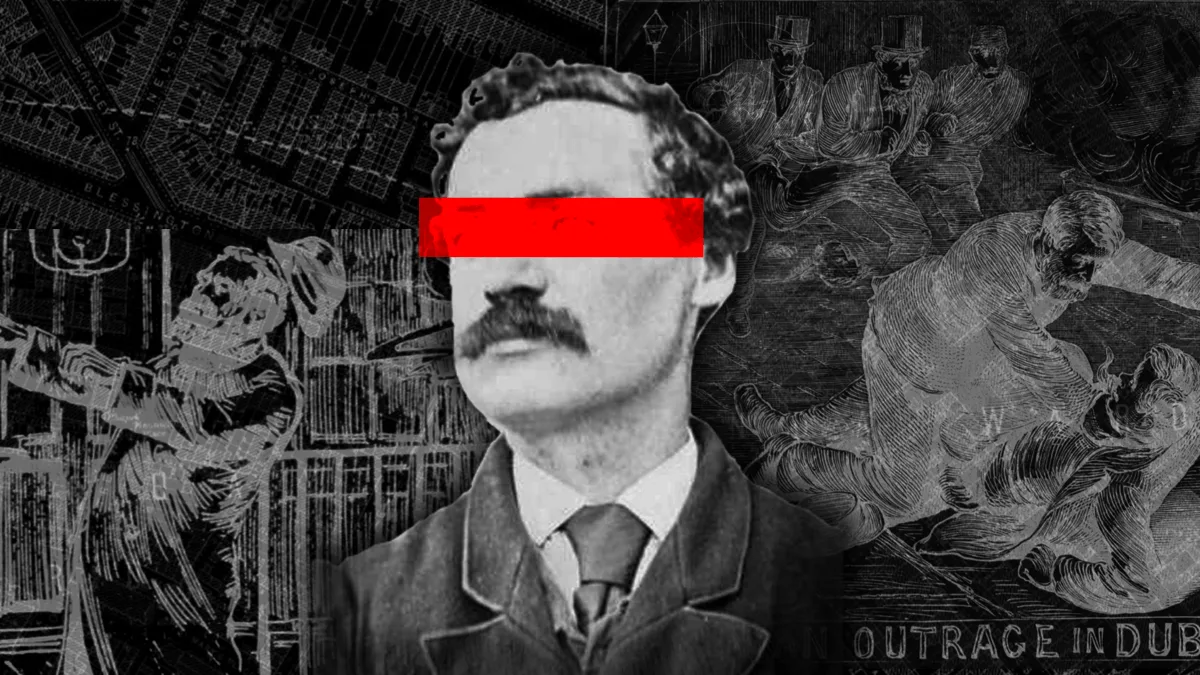
Murder on Hardwicke Street
On a July night in 1871, Thomas Talbot was making his way home to Dorset Street from Morton’s, a pub off Grafton Street. Crossing the Liffey, he continued along Sackville Street and through Rutland Square before reaching Hardwicke Street, spotting the soaring spire of St. George’s Church in the distance.
As he started down the street, a man emerged from the darkness, raised his revolver, and fired. The shot struck Talbot, sending him against the railings, stunned. The shooter ran off while Talbot came to and shouted, ‘Police’ and ‘Murder’.1
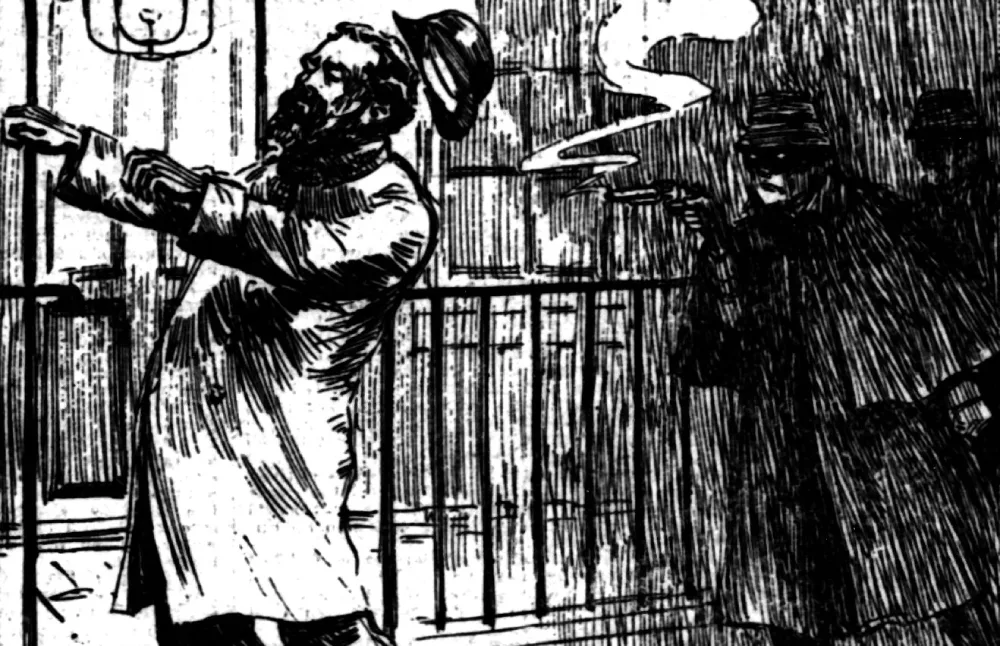
Two nearby policemen heard the shot and went towards the source of the sound. Spotting a man running, they gave pursuit. One constable, James Mullen, stepped out in front of him. The man pointed the revolver and said, ‘Don’t come near me, or I’ll shoot you’. Unarmed, Mullen stood aside, but the pursuit resumed. After another confrontation, the fugitive turned and fired, striking Mullen in the thigh.2
The man threatened passers-by who tried to intervene. Eventually, the second constable, Michael Grimes, managed to tackle the man, striking him on the head with his baton.3
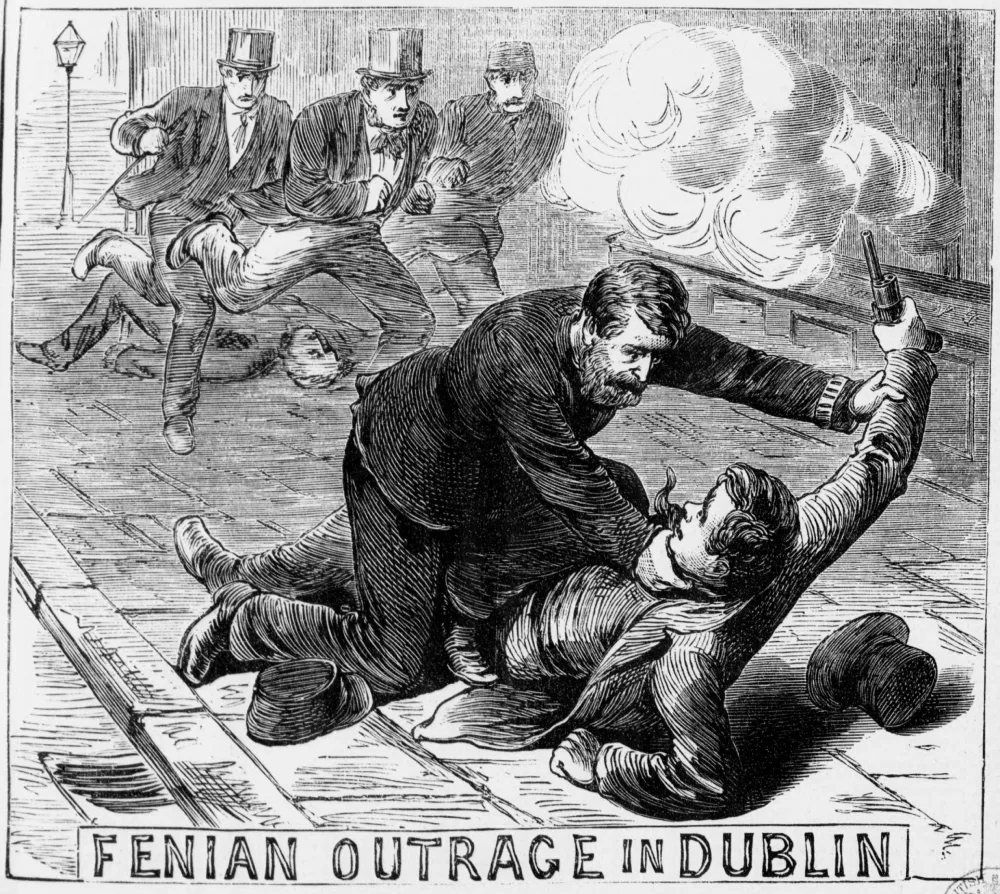
Talbot, meanwhile, had walked alone to Green Street police station, around a kilometre away. He told the inspector on duty what had happened and was taken to Richmond Hospital.4
This was unlikely to have been a random attack. Talbot regularly carried a revolver, had police protection and had been warned against walking Dublin’s streets alone at night.
A Marked Man
Thomas Talbot was a former Head Constable in the Irish Constabulary who had worked as an undercover agent. His notoriety began in Tipperary, where he was sent in 1865 to investigate Fenian activity, adopting the disguise of a water bailiff with the goal of infiltrating the Irish Republican Brotherhood (IRB) in the nationalist stronghold.5
Under the alias John Kelly, he infiltrated Fenian circles in Clonmel and Carrick-on-Suir, attending more than 100 meetings, cultivating friendships and gaining the confidence of local organisers. Though a Protestant, he even attended Catholic Mass and received Communion to lend credibility to his disguise.6
His infiltration exposed a Fenian conspiracy to recruit Ireland-born British soldiers and seize barracks and weapons for a planned uprising. Talbot subsequently became a key Crown witness in the prosecution of numerous Fenians, including soldiers accused of conspiring to mutiny against their commanding officers. He recalled 13 men being arrested in a single morning.6
Among those convicted was John Boyle O’Reilly, whose death sentence in 1866 was commuted to twenty years’ penal servitude.7
His testimony made him a notorious figure among Irish nationalists. Due to his actions in Tipperary, Talbot was awarded a £50 supplement to his pension by the government, bringing its total to £100.1 He retired from the Constabulary in 1869 and lived on Dorset Street.9
In February 1871, five months before the shooting, Talbot was assaulted by two university students at a hotel bar on South Anne Street. One remarked that Talbot ‘the informer’ had arrived and that he would shoot him if he had a revolver. However, the student alleged that this remark was only made after a friend who was accompanying Talbot said ‘damned Fenians’.
A scuffle ensued, and at the subsequent trial Talbot stated that he was indifferent to the pair being bailed, but rather that he feared something worse would happen.10 The Irishman, a nationalist newspaper commenting on the case, compared Talbot to a smallpox patient and he ‘ought to be ostracised’.11
Taking advice from his friends, Talbot was reportedly making plans to emigrate.12
Pemberton
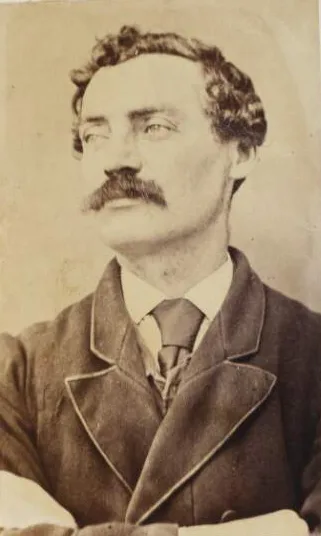
The man was taken to Sackville Lane station where he gave his name as Robert Pemberton, refusing to give his address. He was Robert Kelly, a carpenter in his thirties who told police he was on strike.4 He lived in a cottage with his wife and four children at South Cumberland Place, behind Westland Row station.12,13
Newspapers described Kelly as a low-set man, approximately five feet eight inches tall, closely shaven except for a moustache and poorly dressed.14 He bore a recent wound to his left temple, sustained by Grimes’ baton at the time of his arrest.3 Despite the night’s events, he appeared calm in custody, reportedly falling asleep shortly after reaching the station.14
(Courtesy of the National Library of
Ireland)
The Death of Talbot
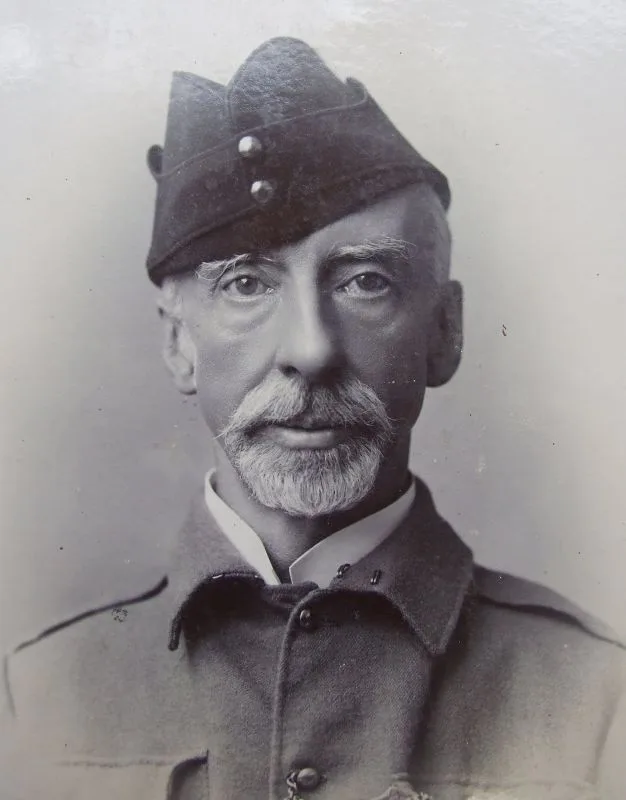
Talbot was conveyed to Richmond Hospital where he was attended to by Dr. William Stokes, who saw the bullet had entered his skull above his left ear.4 The surgeons suspected that it was lodged around the junction of Talbot’s skull and the upper spine. They probed and enlarged the wound in an attempt to locate and remove it. The first operation was unsuccessful. During a second attempt, two arteries were severed, causing significant bleeding before the surgeons managed to tie them off.15
Talbot’s condition was critical, yet he remained conscious and able to answer questions. Arrangements were made to take his sworn deposition before magistrate Joseph William O’Donnell.
Inspector Mulholland later brought Kelly into Talbot’s hospital room. Upon seeing him, Talbot pointed and declared, ‘There’s the man’.
Mulholland replied, ‘What man?’
‘The man that shot me’.
‘Which man do you mean?’
Talbot added, ‘That’s him I mean. Turn him round until I look at his back’.
When Kelly was halfway turning, he remarked, ‘That’s the man’.16
Kelly and Talbot had crossed paths before. On previous occasions Kelly had visited the same pub that Talbot was leaving that night. The publican said Kelly had done some carpentry work there, and she had seen the pair together on at least two occasions.16
Although weak on Friday, Talbot appeared to improve on Saturday, sitting up, eating, and reading newspapers. That evening, however, he became agitated, predicted his own death and asked for his brother.
Around 6am the next morning, his brother noticed Talbot’s wound bleeding. Although the bleeding was controlled, Talbot became increasingly delirious and agitated. At one point, several people were needed to restrain him for an hour. He entered a coma and, just before 4pm, Talbot died in his hospital bed.17
The Inquest
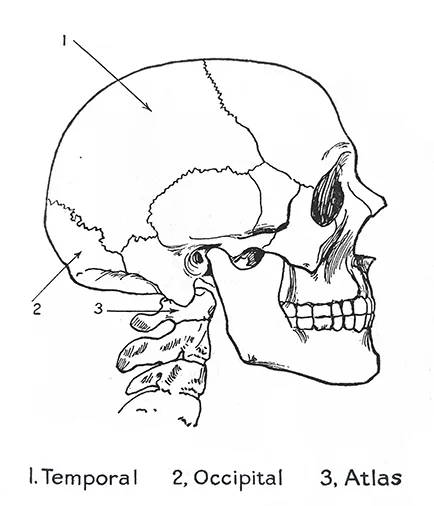
A post-mortem, conducted by Stokes and resident medical pupil Agmon Vesey, revealed bullet fragments lodged in Talbot’s skull, between the temporal and occipital bones, and a fracture of the atlas, the uppermost vertebra. An abscess and severe inflammation had developed around the upper spinal cord.15
Courthouse’)
The inquest was held on the 17th of July in the operating theatre of Richmond Hospital. Kelly’s counsel successfully sought an adjournment because the prisoner was absent and unable to hear the evidence or assist his defence.18
The inquest resumed on the 25th of July in Richmond Hospital’s lecture hall. The proceedings sometimes resembled a theatrical performance. Medical students laughed when a juror struggled to raise a window, then applauded when the coroner failed in the same attempt.19
It became heated when Kelly’s counsel, Patrick Keogh, challenged Stokes over his attempts to extract the bullet. Keogh declared, ‘I am trying to make out that you know nothing at all about the matter’, drawing hisses from the gallery. Stokes retorted that he was there to explain his medical opinion, ‘but not to be insulted by any ignorant person’, prompting applause. The confrontation eventually forced a brief adjournment.
The central question was whether the gunshot wound or the surgeons’ interventions had caused Talbot’s death. Dr. George Porter attributed the death to an abscess and inflammation around the brain and spinal cord. While acknowledging that excessive probing could be fatal, he believed Talbot would have died regardless of the operations.
The jury was asked only to determine the cause of death, not the identity of the gunman. They returned and gave their verdict that Talbot died from the effects of a gunshot wound.19
Trial at Green Street
The Dublin Commission Court sat at Green Street on the 10th of August, beside the Dublin Metropolitan Police (DMP) station that Talbot had initially sought assistance in. Kelly was indicted for the murder of Talbot.
His counsel applied for an adjournment to prepare his defence.20 The subsequent trial was then again postponed due to a lack of jurors attending.21 As Kelly was escorted from the courthouse following the second adjournment, a woman cried out ‘Hurrah for Kelly!’ which received a cheer from the crowd.22
As October closed, the trial restarted. Kelly was escorted from Kilmainham Gaol with three troops of cavalry and a large body of mounted constables in what was a major policing operation. The route to the courthouse was thronged with onlookers. However, the Freeman’s Journal noted that, this time, the crowd remained silent.23 At the courthouse DMP constables were posted around the exterior and surrounding streets. Admission into the courtroom was strictly controlled, with people requiring tickets.
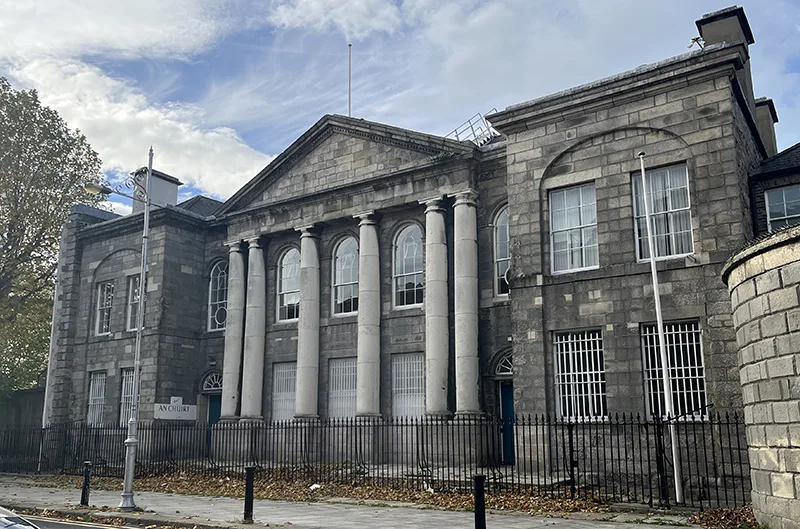
By 10:30am, Lord Chief Justice James Whiteside and Chief Baron David Richard Pigot had taken their seats. Kelly stood in the dock ‘perfectly cool and collected’, while his father sat in the benches behind him. Jury selection lasted nearly four hours.23
Among Kelly’s defence counsel was Isaac Butt, a Donegal-born Protestant barrister who was president of the Amnesty Association and had defended leaders of the failed Fenian Rising in 1867, as well as founding the Irish Home Rule movement.24
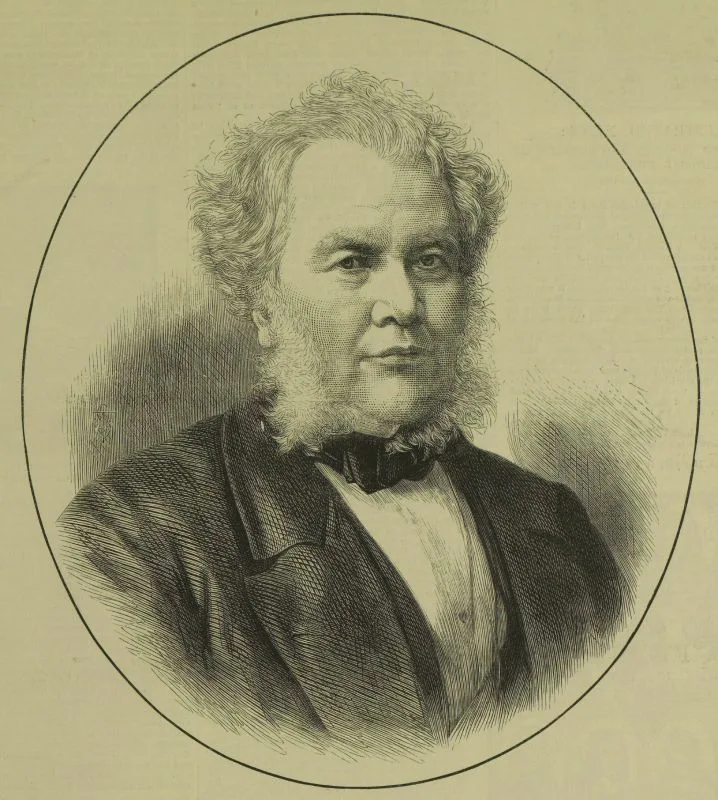
London News’, 17 May 1879)
The defence challenged both Kelly’s identification as the gunman and the claim that the gunshot wound, rather than the subsequent medical treatment, had caused Talbot’s death.
Who Shot Talbot?
The prosecution reconstructed the shooting and pursuit. While none of the witnesses called to the trial had seen the shooting itself, police officers and bystanders identified Kelly as the armed man fleeing the scene, threatening those who attempted to intervene before shooting Constable Mullen. The Crown therefore relied heavily on Talbot’s hospital deposition to establish that the fugitive was also the man who had shot him.
Witnesses testified that Talbot had been sober shortly before the attack, supporting the prosecution’s contention that he could recognise his assailant. However, the Crown could establish no definite motive for the shooting.
Although witnesses identified Kelly as the armed fugitive pursued by police, nobody had seen Talbot being shot. Talbot himself had mentioned other men in the archway near the scene, while another witness described seeing three unidentified men walking slowly towards the archway shortly before the shooting.25 Their subsequent movements were unknown.
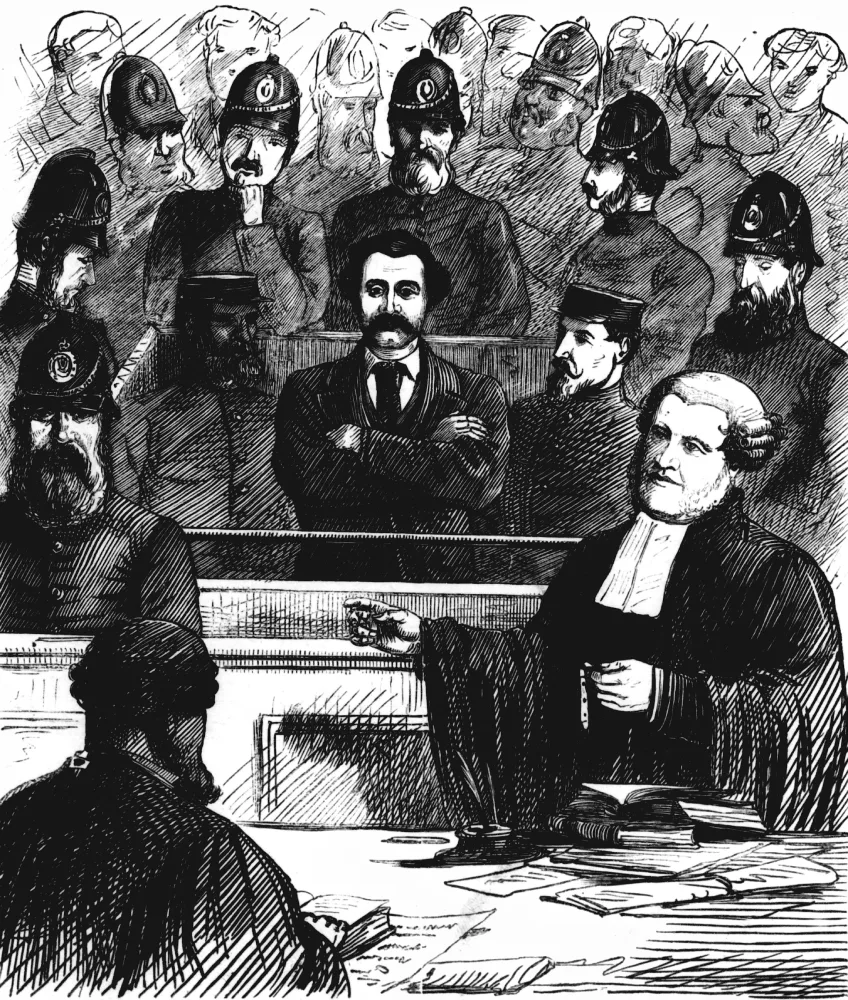
Court clerk Edward Daly confirmed that Talbot had described more than one person in the archway and added that the gunman turned into the archway after the shooting. The defence suggested that the original attacker might therefore have escaped by another route, although no witness could confirm this.26
The reliability of Talbot’s identification of Kelly at Richmond Hospital was also challenged. Inspector Mulholland testified that Talbot recognised Kelly but could not swear that he had seen Talbot point towards him.
Daly, who recorded Talbot’s sworn deposition, gave a more definite account, stating that Talbot had raised his hand and pointed towards Kelly, allowed it to fall back onto the bed, then raised it again and pointed distinctly at the prisoner.26 With Kelly having been brought directly before the wounded man by police, the defence questioned whether the identification could be relied upon to establish that he had fired the original shot.
The revolver recovered from Kelly also raised questions. Although four chambers were empty, a gunsmith believed only three cartridges had been discharged. Disputes over the weapon’s condition prevented the examination from conclusively establishing whether it had fired the shot that wounded Talbot.16
The defence further argued that, if Kelly was the shooter, it was not the bullet that killed Talbot. After all, Talbot was able to walk himself to the police station and was conversing in his hospital bed. Butt maintained that the surgeons’ repeated attempts to locate and remove the bullet, including the division of an artery and subsequent haemorrhage, might have caused or materially contributed to his death. Butt accused Stokes of displaying ‘excess of arrogance and folly.’
Surgeons on Trial
Stokes was called to the witness box. He acknowledged that he had never successfully extracted a bullet from a living patient. Despite an inconclusive examination from a Nélaton probe, intended to detect lead, the surgeons had enlarged Talbot’s wound in an attempt to remove the projectile. Stokes maintained that it was due to the seriousness of the wound and the dangers posed by a retained bullet.26
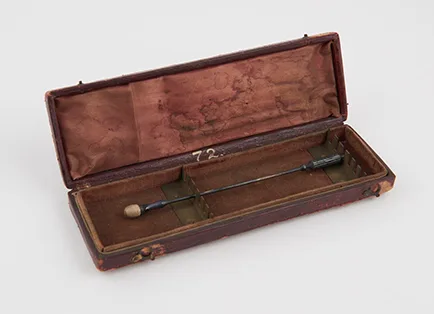
University College Hospital, London)
Butt questioned whether the fracture of Talbot’s atlas had been caused by the bullet itself or the surgeons’ instruments. Stokes attributed the fracture and subsequent inflammation to the gunshot wound, rejecting the suggestion that blood loss during the operations had caused Talbot’s death.26
Butt then questioned Agmon Vesey, who had attended to Talbot in Richmond Hospital during his final days. It transpired that Vesey had made notes on his condition, describing his surgery, his increasing delirium, his violent struggle and his death. There were two different accounts – original notes written in a notebook and a later revised version prepared while Talbot’s inquest was adjourned. Butt demanded the notebook and a messenger was sent to fetch it.
In the original notes, Talbot was recorded as ‘very weak from loss of blood’. This was changed to ‘very weak’, removing the explicit connection with the haemorrhage. Vesey had also amended Talbot’s blood loss from a soup plateful to a clot plus slight oozing. He was also described as being ‘lifted’ onto the operating table whereas in the later account he was ‘helped’, painting Talbot as having some independence.17
Vesey denied concealing evidence, insisting that the revisions corrected earlier inaccuracies and reflected subsequent consultations with colleagues or reconsidering his recollection. He could not, he said, confidently attribute Talbot’s weakness to blood loss.
Another witness who had been present during the operation described seeing blood spurt onto the coats of two surgeons, contradicting Stokes’s account of the bleeding. Dr. Robert McDonnell, who had assisted during the procedure, acknowledged that his participation did not necessarily mean he considered it the best course of action, although he had not voiced any objection at the time.27
The defence also called Dr. William Hegarty O’Leary, who had later examined the preserved portions of Talbot’s skull and atlas. He disputed whether the bullet fragments could explain the fracture and suggested that fever and blood loss, rather than spinal-cord inflammation, might account for Talbot’s deterioration. However, he had not treated Talbot and relied on medical records and preserved specimens.28
A Case of Credibility
The defence then turned its attention to Talbot’s credibility, referencing his clandestine activities in Tipperary a half-decade prior. Witnesses familiar with his activities as an informer were called to question whether he could be trusted on oath, although the prosecution objected to attempts to introduce evidence about his character.
One witness, John Francis Meagher, from Carrick-on-Suir, who had encountered Talbot during his undercover activities in Tipperary, was arrested based on Talbot’s information and held in custody for eight months. He labelled Talbot ‘a habitual drunkard’ and recalled that he went to Mass with Talbot on several occasions, noting one time Talbot ‘knocked out the prayer for the Queen – crossed it out with his pencil’. When Meagher said he shouldn’t have done so, Talbot replied that it was ‘all fudge’. The prosecution questioned whether Meagher’s own imprisonment had influenced his opinion of Talbot, to which Meagher agreed.29
As the trial continued, Richard Pigott, proprietor of The Irishman which had previously compared Talbot to a ‘smallpox patient’, became embroiled in contempt-of-court proceedings over the newspaper’s coverage of the case. The Crown objected to several articles published during the prosecution, including one referring to the Lord Chief Justice.30 Represented by Butt, Pigott denied writing that article or seeing the issue before publication.
The Verdict
In his final charge, Chief Baron Pigot reminded the jury that negligent medical treatment did not necessarily absolve an attacker if the original wound had caused the death.
The prosecution nevertheless had to establish that the wound caused Talbot’s death. Pigot urged caution over Talbot’s identification at Richmond Hospital. Kelly was presumed innocent, and any reasonable doubt required an acquittal.
The jury retired at 4:15pm to discuss their verdict, bringing with them a map, a cartridge and the bullet. As they deliberated, they requested the three pieces of metal that were removed from Talbot’s atlas.
At 6:30pm, the jury-room door creaked open, bringing a sudden hush to the courtroom. The jurors briefly emerged but were sent back while the judges were summoned. Rumours spread that the verdict would go against Kelly.
At 7:10pm, the judges returned. Kelly was ordered to be put forward, standing in the dock ‘perfectly calm and firm’, watching the jury as the clerk asked whether they had reached a verdict. The foreman replied that they had.
‘What is it?’
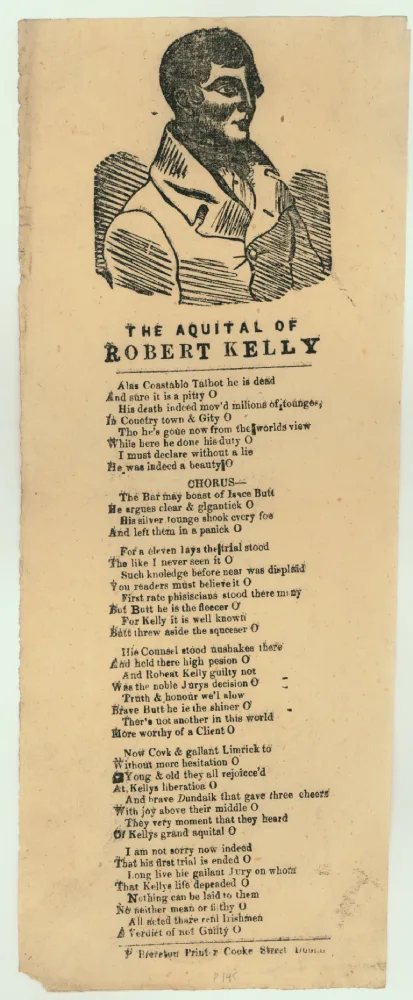
celebrating Robert Kelly’s
‘aquital’ (Courtesy of the
University of Notre
Dame)
‘Not guilty’.
Impassive, Kelly was removed to Kilmainham.30 The news was met with loud cheering outside the courthouse. Later that night, a large crowd gathered outside one of the defence team’s, Frederick Falkiner’s, house on Mountjoy Square West.
After cheering him, they proceeded to Butt’s residence on Eccles Street. Butt appeared at his door and thanked them. He described the day’s result as a great constitutional triumph and spoke about gaining another victory concerning the rights and privileges of the press, referencing Pigott’s ongoing defence.30 However, three days later The Irishman proprietor was sentenced to four months in Richmond Prison for contempt of court and obstruction of public justice.31
News of Kelly’s acquittal also prompted celebrations in Cork, where bands paraded through the streets and crowds cheered the verdict.32
Kelly’s freedom, however, was far from assured. He still faced a separate charge arising from the shooting of Constable Mullen.
The Second Trial
After another adjournment, sought by Butt over prejudicial English newspaper coverage, Kelly’s second trial began at Green Street in February 1872.33
With numerous eyewitnesses, the prosecution’s case was considerably more straightforward, though Butt nevertheless argued that the shot was accidental. A reporter remarked that Kelly’s hair had acquired grey streaks since the commencement of the first trial in October, and he had ‘fattened considerably’.34
After a two-day trial and a 50-minute deliberation, the jury found him guilty. Before his sentencing, Kelly read a statement out to the courtroom. He claimed he was on Blessington Street and followed two or three men who were running away, picking up a small pistol that was on the ground. Then, once the police were pursuing him, the shot was fired accidentally as his trousers were falling off him. He was beaten by the police and two bystanders before being brought to Talbot’s hospital room, who identified him after emerging from his ‘drunken slumbers’.
Judge Michael Morris sentenced him to fifteen years’ penal servitude. His wife burst into tears in the gallery, while Kelly appeared unmoved. As he left the courthouse amid a crowd, the wagon trundled towards Mountjoy Prison.34
The prison authorities were conscious of the attention Kelly’s case had attracted. In October 1872, the governor noted that special precautions should be taken for his safe custody, owing to the considerable feeling shown towards him by people outside the prison.13
To Spike Island
After eight months in Mountjoy, Kelly emerged from the prison in a cab accompanied by nine policemen. He was being taken to Kingsbridge Station and from there he was transported to Spike Island, a notorious prison in Cork Habour.35 Convicts endured hard labour, harsh discipline and, at times, appalling conditions within the walls of a former military fortress. While his removal was intended to be a secret, several people witnessed it.
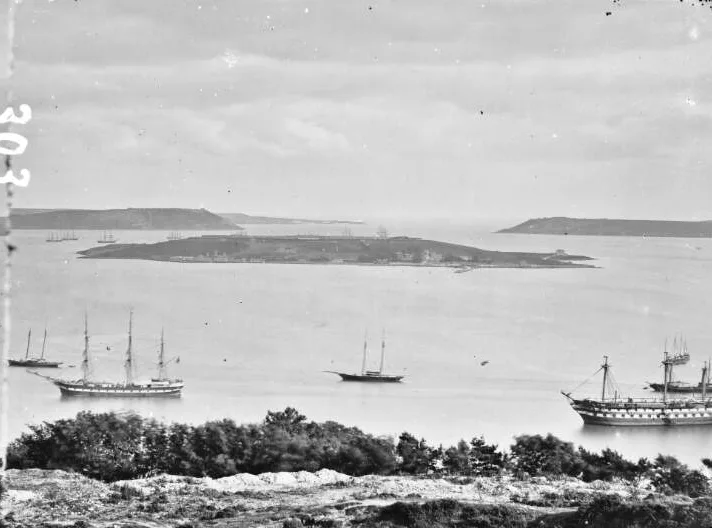
of Ireland)
Kelly later claimed that while on the train, he encountered Frank Byrne, an IRB member. Kelly said that Byrne bought him a sandwich. When a policeman objected, Byrne replied that it was not ‘against humanity’.
Kelly further added that Byrne had organised an escape, where the train would be stopped near Blarney. There, the escort would be overpowered and he would be taken in waiting carriages to a waiting vessel. The plan never materialised.36
The story is difficult to verify. Byrne had died the previous month, leaving him unable to confirm or challenge Kelly’s account.
Ticket of Leave
Kelly remained on Spike Island for six years. He was transferred back to Mountjoy and three months later, in August 1878, he was released on a ‘ticket of leave’ by the Lord Lieutenant of Ireland. This was an early form of parole that left Kelly’s original sentence hanging over his head or, as he called it, dragging a long chain with him for the rest of his life.37
On a Saturday morning, Kelly walked away from Mountjoy and the prison system in civilian clothes with £4 4s 8d in his pocket.38 Physically, it was clear the toll that the conditions in Spike Island had taken on him, and he went to a doctor in Gardiner Street based on the appeals of his friends. A journalist commented that he was weak, his heart was beating up to 100 beats per minute, the muscle had dissolved from his limbs, and his mouth was more gum than teeth.39
The Freeman’s Journal, recalling Talbot’s role as an informer, was particularly scathing: ‘To speak of Talbot at all would be to raise the memory of a life of a desperate man – one who, amongst other countless sins, had assumed the cloak of religion to forward the ends of the daring and disreputable task he took in hand for the Government.’38
A ‘Kelly Testimonial Fund’ was established under the management of IRB treasurer James Carey, helping raise money for Kelly and his family.40
Across the Atlantic
Four years later, Kelly emigrated to the United States, where he gave interviews recounting his experiences. One such report not long after his arrival had Kelly maintain that he was in the Hardwicke Street area that night by chance. He lamented that two of his children had died whilst he was imprisoned, as well as a number of friends and relatives.
In search of work, Kelly ended up in England where, one night, he was walking down a street in Birmingham when he saw a poster for a play by Dion Boucicault. He went into the theatre and sent a note to Boucicault asking for help to go to the United States. Boucicault seemingly obliged and the article closes with Kelly wishing to establish a home for his wife and children.41
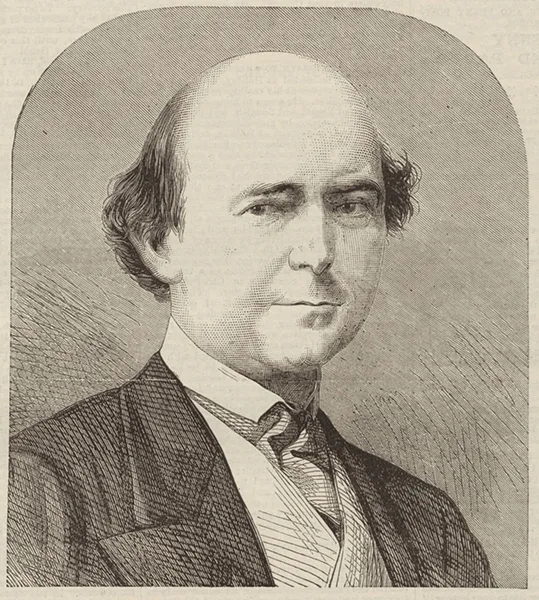
‘The Penny Illustrated Paper’, 8 June
1872)
By 1886, Kelly was reportedly living ‘in utterly destitute circumstances in the city’, with his health deteriorating.42 He reemerged for another interview in 1894, with his situation now being even more precarious. Kelly was living in ‘poor rooms’ in Manhattan, behind on rent and unable to work due to what he says was a broken wrist sustained during his arrest. He showed the reporter letters from John Boyle O’Reilly and reminisced of seeing Daniel O’Connell speak as a boy. Talbot was described as an arrogant man who deemed himself untouchable.
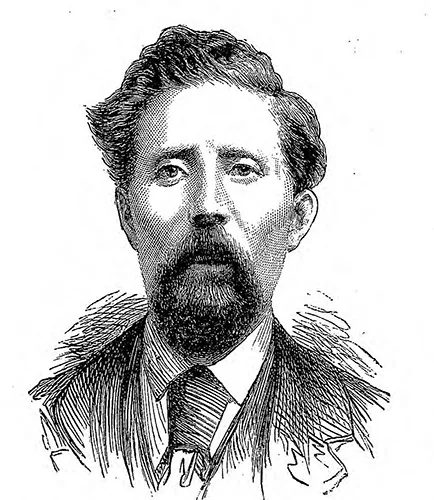
Graphic’, 4 August 1883)
Furthermore, he claimed that it was James Carey, the IRB treasurer since assassinated for turning informer in the Phoenix Park Murders trial, who gave information against him and who also gave Kelly the pistol that night.36 However, this conflicts with Kelly’s testimony during the court proceedings in 1872 that he picked it up off the ground.
Kelly also described his separation from his wife and the deaths of his youngest child and eldest son, the latter during the Sudan War. Recounting his encounter with Dion Boucicault once more, he now placed it in Liverpool rather than Birmingham, as he had in 1882.36
To the Grave
By 1903, Kelly had returned to Dublin. That September, he entered the South Dublin Union Workhouse, remaining there until the following March.43
Kelly later found employment with the Dublin Corporation and gradually faded from the public consciousness. Yet his association with Talbot’s shooting persisted. In 1909, he brought a libel action against Lloyd’s Weekly News and former DMP detective John Mallon over an article identifying him as a gunman.44 He was awarded £100.45
In 1913, Kelly brought another libel action, this time against the Freeman’s Journal, after it identified Kelly as the man who shot Talbot. He again denied this, though acknowledged that he was a member of the Fenian Society in 1871.
Kelly told the court that even after more than 40 years, people still pointed him out in the street. As he described the effect on his life, he broke down in the witness box. The judge called the action an ‘audacious case’, yet awarded Kelly a shilling in damages.45
In 1914, in poor health and unable to work, Kelly walked through the door of the South Dublin Union Workhouse again. With his age recorded in the ledger as 80, he was one of the oldest residents in the building.46
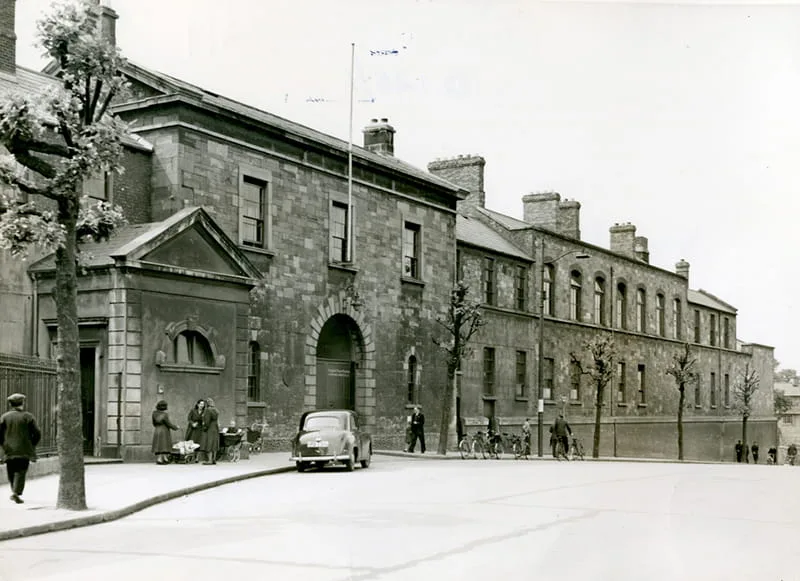
On 1 June 1918, the front page of the Freeman’s Journal, which Kelly had taken to court five years earlier, carried headlines predicting the end of Home Rule and noting the German army’s territorial gains in France. Among them was another:47
DEATH OF MAN WHO SHOT TALBOT
Robert Kelly had died four days earlier in the workhouse, with his cause of death listed as rheumatic arthritis.48 Nearly 47 years had passed since the shooting on Hardwicke Street and his acquittal at Green Street. He was imprisoned, emigrated, returned to Ireland and twice sought legal redress against newspapers that identified him as the killer.
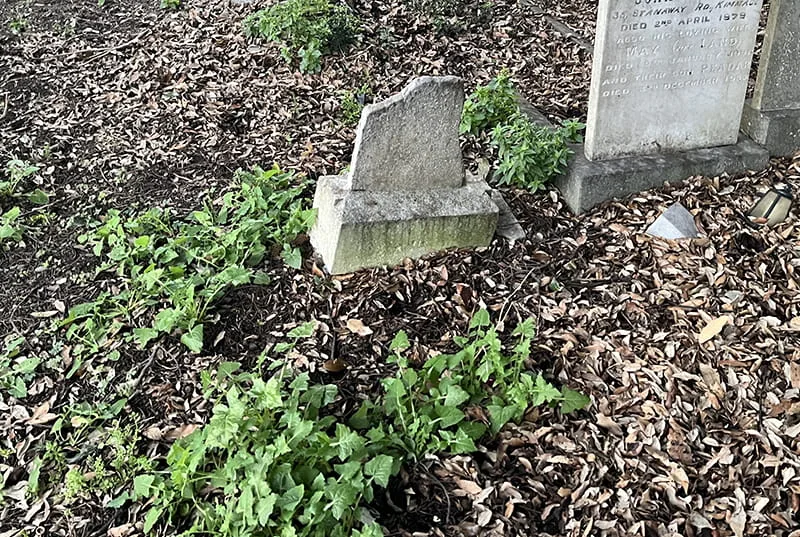
Yet in death, as in life, he remained known as the man who shot Thomas Talbot.
References
- ‘The Attempted Murder of Constable Talbot’, Dublin Evening Mail, July 13, 1871, 3.
- ‘Attempted Assassination of Head Constable Talbot’, Dublin Evening Post, July 12, 1871, 2.
- ‘Attempted Assassination of an Informer’, The Nation, July 15, 1871, 5.
- ‘Attempt to Murder Constable Talbot’, Dublin Evening Mail, July 12, 1871, 3.
- ‘Alleged Fenianism in the Army’, Belfast Weekly News, June 2, 1866, 5.
- ‘Queen v. John McCafferty: Trial Transcript’, Trial transcript, May 3, 1867, FO 5/1344, The National Archives.
- Ian Kenneally, From the Earth, A Cry: The Story of John Boyle O’Reilly, (Collins, 2011).
- ‘The Fenians and the Irish Constabulary’, The Liverpool Weekly Courier, September 14, 1867, 2.
- ‘Royal Irish Constabulary service record of Thomas Talbot’, Police service register, October 13, 1846, HO 184/4, service no. 7648, The National Archives.
- ‘Charge of Assault’, Saunders’s News-Letter and Daily Advertiser, February 27, 1871, 3.
- ‘“Head Constable” Talbot’, The Irishman, March 4, 1871, 16.
- ‘The Attempted Assassination of Head-Constable Talbot’, The Nation, July 22, 1871, 18.
- ‘Mountjoy Prison convict classification register entry for Robert Kelly’, Prison register, February 9, 1872, Mountjoy Prison, Convict Classification Register, 1870–1880, 1/11/25, National Archives of Ireland.
- ‘Attempted Assassination of Thomas Talbot’, Dublin Evening Telegraph, July 12, 1871, 2.
- William Stokes, ‘Case of Fracture of the Atlas from Gunshot Injury’, BMJ 2 no. 573, (1871), 716–718, https://doi.org/10.1136/bmj.2.573.716.
- ‘Trial of Kelly for the Alleged Murder of Constable Talbot’, Freeman’s Journal, November 1, 1871, 3.
- ‘Trial of Kelly for the Alleged Murder of Constable Talbot’, November 6, 1871, 3.
- ‘Death of Talbot – The Inquest’, Freeman’s Journal, July 18, 1871, 4.
- ‘The Shooting of Talbot’, Freeman’s Journal, July 26, 1871, 4.
- ‘Second Edition’, Dublin Evening Post, August 11, 1871, 2.
- ‘Commission of Oyer and Terminer’, Dublin Evening Post, August 14, 1871, 3.
- ‘Commission Court-Yesterday’, Freeman’s Journal, August 15, 1871, 6.
- ‘Trial of Kelly for the Alleged Murder of Constable Talbot’, Freeman’s Journal, October 31, 1871, 4.
- ‘Epitome of News’, The Dundalk Herald, March 11, 1871, 6.
- ‘The Kelly Trial’, Dublin Evening Telegraph, November 11, 1871, 4.
- ‘Trial of Kelly for the Alleged Murder of Constable Talbot’, November 2, 1871, 3.
- ‘Trial of Kelly for the Alleged Murder of Constable Talbot’, Freeman’s Journal, November 7, 1871, 3.
- ‘Trial of Kelly for the Alleged Murder of Constable Talbot’, Freeman’s Journal, November 8, 1871, 4.
- ‘Trial of Kelly for the Alleged Murder of Connstable Talbot’, Freeman’s Journal, November 9, 1871, 4.
- ‘Trial of Kelly for the Alleged Murder of Constable Talbot’, Freeman’s Journal, November 11, 1871, 4.
- ‘The Sentence’, Dublin Evening Post, November 13, 1871, 3.
- ‘This Day’s News’, The Tuam Herald, November 11, 1871, 3.
- ‘Last Week’s Postscript’, The Nation, December 16, 1871, 20.
- ‘Trial of Robert Kelly’, Freeman’s Journal, February 10, 1872, 4.
- ‘Removal of Robert Kelly From Mountjoy to Spike Island’, Dublin Evening Telegraph, October 8, 1872, 3.
- ‘Like a Romance’, The Nationalist and Leinster Times, March 31, 1894, 9.
- ‘Release of Robert Kelly’, The Weekly Freeman and Irish Agriculturist, August 10, 1878, 7.
- ‘Release of Robert Kelly’, Freeman’s Journal, August 5, 1878, 3.
- ‘Release of Robert Kelly’, August 10, 1878, 4.
- ‘Robert Kelly Testimonial Fund’, The Flag of Ireland, August 10, 1878, 8.
- ‘The Man Who Shot Talbot’, The Derry Journal, January 30, 1882, 6.
- ‘Robert Kelly’, The Clare Journal and Ennis Advertiser, August 16, 1886, 3.
- ‘South Dublin Union admission and discharge register entry for Robert Kelly’, Workhouse admission and discharge register, 1903, BG/79/G/136, workhouse no. 1392, National Archives of Ireland.
- ‘On Secret Service’, Dublin Evening Telegraph, June 29, 1909, 3.
- ‘Memories of ’67.’, Freeman’s Journal, February 18, 1913, 7.
- ‘South Dublin Union admission and discharge register entry for Robert Kelly’, Workhouse admission and discharge register, 1914, BG/79/G/136, workhouse no. 2406, National Archives of Ireland.
- ‘Death of Man Who Shot Talbot’, Freeman’s Journal, June 1, 1918, 1.
- ‘Death registration of Robert Kelly’, Civil death registration, May 26, 1918, No. 1 South City registrar’s district, South Dublin superintendent registrar’s district, entry 483, General Register Office, Ireland, https://www.irishgenealogy.ie/files/civil/deaths_returns/deaths_1918/05188/4432801.pdf.