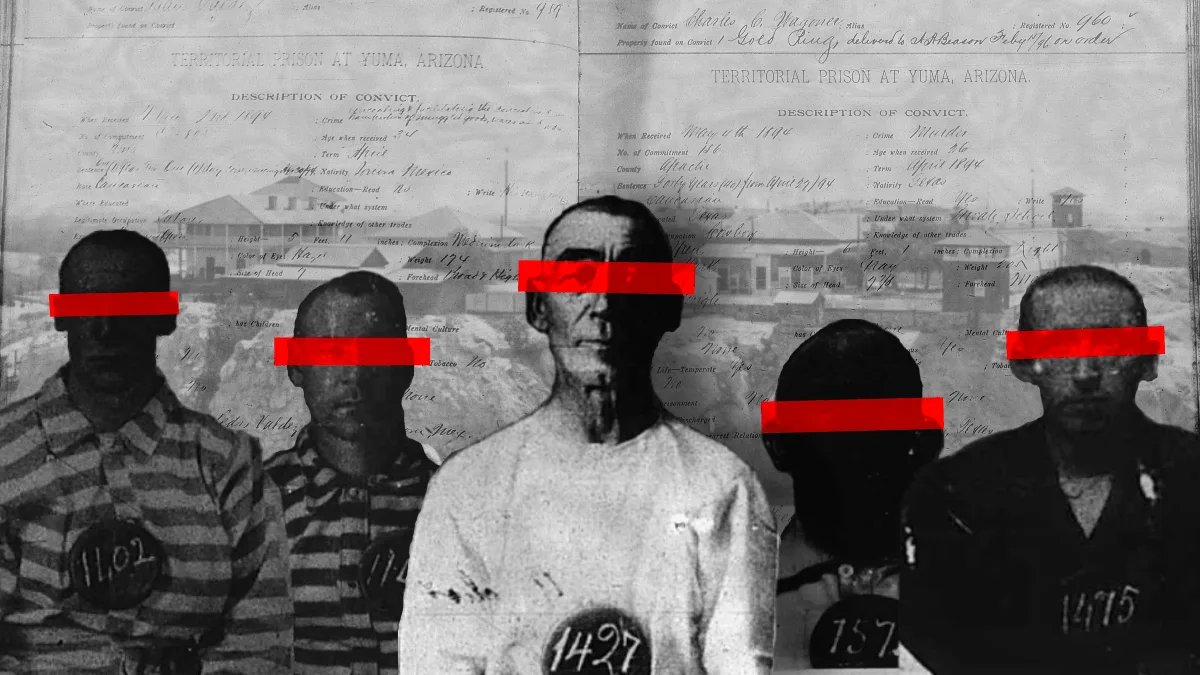
One murdered a railway foreman. Another escaped from prison. A third insisted that he deserved his sentence, even as others campaigned for his release. Five Irish emigrants found themselves inside Arizona’s Yuma Territorial Prison, where their stories briefly entered the historical record before almost disappearing again.
The records of the infamous prison in southwestern Arizona list thousands of prisoners. Upon entering its adobe walls, each inmate was photographed and documented in considerable detail. Entries recorded the prisoner’s crime, sentence and assigned number, alongside physical measurements, eye colour, scars, religion, mental state and even whether they consumed opium.
One line records the prisoner’s country of origin. Although various US states and Mexico dominate the register, a small number of inmates were born in Ireland. The register was created to identify and control prisoners, but more than a century later, those same details allow parts of their lives to be reconstructed.
A Case for Mercy
Frank Delaney
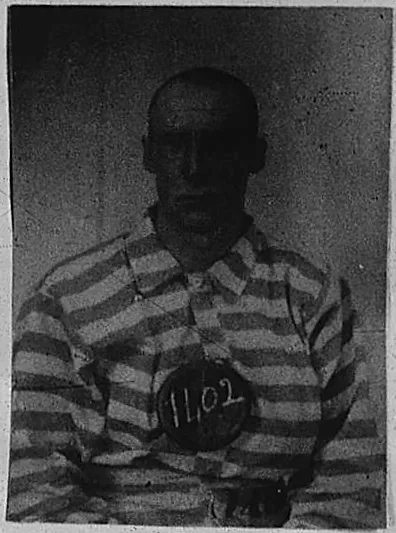
Early one Monday morning in 1898, midway between Flagstaff and Winslow, a construction train was carrying railroad workers. Frank Delaney was asleep in one of the cars when foreman Ed Madden walked in. He kicked Delaney awake. A fight ensued, and Madden got the better of 5-foot-5-inch Delaney, leaving him bruised.1
A few minutes later, Delaney searched through his bundle of clothes to find what he was looking for: a pistol. He returned to Madden, raised the gun, and shot him above his left eye. Madden died of his wound later that day. Delaney was taken to Yuma to serve a life sentence for second-degree murder.2
Prison officials recorded his details and photographed him. He was 32 years old, educated in Dublin, and described as having a “florid” complexion. He sported red hair and a moustache, both of which were soon shaved off, as was customary for inmates. Officials also noted that he possessed $5.75 upon arrival.
Over the following years, Delaney’s sentence increasingly came to be viewed as excessive, while Madden was portrayed as the aggressor. Prominent citizens of Coconino County signed a petition urging the governor to commute his sentence.3 On his final day in office, Alexander Oswald Brodie, Governor of the Arizona Territory, reduced Delaney’s sentence to 25 years’ imprisonment.4 Less than two years later, in June 1908, he was paroled.
What he did afterwards is unknown. In 1913, Governor George Hunt granted Delaney a full pardon, restoring his citizenship. A Coconino County newspaper reported that between his parole and pardon, he had lived “an exemplary life”, suggesting that he remained in the community.5 His trail disappears at this point. Whether Delaney’s pardon corrected an injustice or merely reflected a more sympathetic interpretation of the crime, the official record ultimately left room for mercy.
The Prisoner with Ireland on His Arm
Tim O’Brien
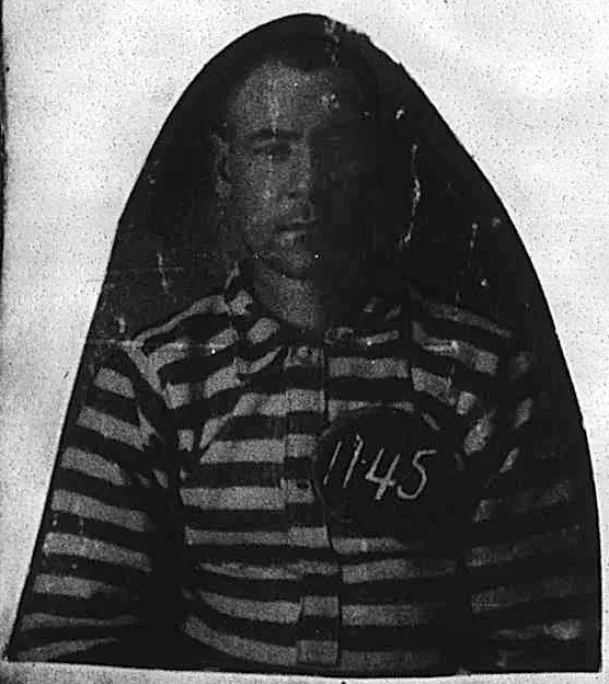
Stout and compactly built. Left arm mashed between two drawheads. The word “ERIN” tattooed on left forearm. These were among the features listed for Tim O’Brien as he entered Yuma in March 1896. O’Brien’s body told a story of its own. ERIN, coupled with a shamrock and the Stars and Stripes, spoke of both an Irishman and an American. His crushed arm and crippled left hand reflected the everyday dangers of the era. Now, his body was covered by the black-and-white stripes of a Yuma prisoner, following his conviction for robbery.
Born in Ireland, the register notes him as having been educated in the US, suggesting he emigrated at an early age. O’Brien arrived in Williams, Arizona around 1892, working for the Saginaw Lumber Company.6 Before moving west, he had lived in Bay City, Michigan, where he was convicted of battery and accused of shooting at a police officer.7, 8
O’Brien and three others were indicted for robbery, with he and one other convicted. By his own account, he had been framed and that he was in the theatre with his wife and children when the crime occurred. He added that the prosecution was “spite work”, motivated by his earlier assault on a Williams lawyer during an election.6
Nevertheless, he had been sentenced to five years. He worked as a “trusty” at the prison farm, implying some degree of confidence from the officials, as trusty status allowed prisoners greater freedom of movement.
In October 1897, while working, O’Brien struck a guard with a paint pail, knocking him down. According to his later account, he reached the nearby Colorado River, where he found a small boat. He then drifted south towards the Gulf of California. There, he boarded a flatboat, obtained a gun and forced its owner to surrender his clothes. He then crossed the arid Colorado Desert before arriving in San Diego.6
He claimed that, while in San Diego, he learned that the superintendent of Yuma Prison had said he would not be pursued as long as he remained outside the Arizona Territory. This led him to return to his former home in Michigan. The police, however, kept him under observation and arrested him after receiving instructions from Arizona to detain him. O’Brien reportedly declared that he would not remain imprisoned and that the officers would have to catch him again.9
He was only half right, as Arizona declined to pay the cost of sending an officer to retrieve him, so the Bay City authorities released him.10 In 1914, he received a pardon that restored his citizenship.2 Yuma measured O’Brien’s body, catalogued his scars and photographed his face. It proved far less successful at keeping hold of him.
Pipe Line Jimmy
James O’Connell
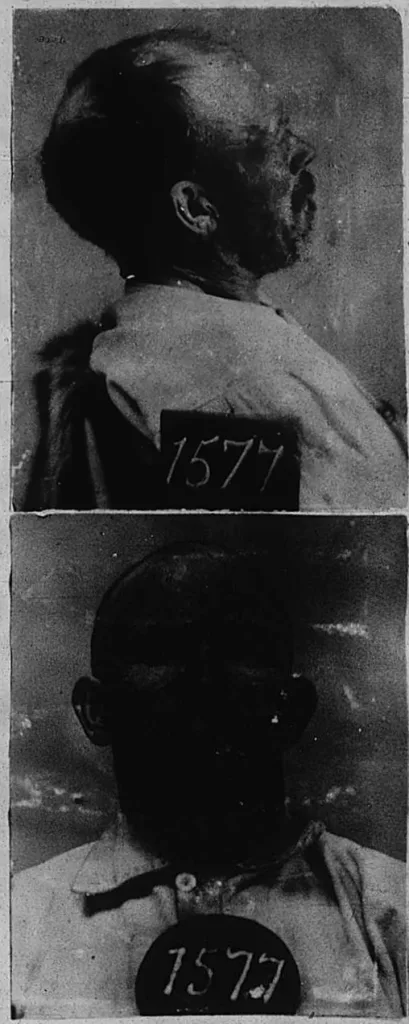
“Pipe Line Jimmy” was a familiar figure in the mining town of Jerome, tucked in the Black Hills of central Arizona. Born James O’Connell, he worked as a pipefitter on the local water line, from which he acquired the nickname.11
The Yuma records describe the Irish-born O’Connell as having been educated in Australia, before ending up in the American Southwest. “Short and heavy”, he also had a scar running across the top of his head. In addition to pipefitting, the register listed mining among his trades – unsurprising in a town built around the industry.
O’Connell entered Yuma after being convicted of assault with a deadly weapon. In the early hours of a November morning in Jerome, O’Connell stood beside a range in a café, warming himself. A Chinese worker at the restaurant told him to move on, placing a hand on O’Connell’s shoulder. Angered, he seized a butcher’s knife from a table and, with one swing, slashed the man’s neck. The wound nearly severed his jugular vein. Blood poisoning developed and the victim was unable to walk for several days, with it feared he may die. Contemporary reports did not record the victim’s name, referring to him only by the period’s derogatory term “Chinaman”.12, 13
A plea of insanity was entered on O’Connell’s behalf, but he was convicted and sent to Yuma in December 1899 to serve his year-long sentence.14 He later claimed he remembered nothing of the attack.
A petition was circulated in Jerome aiming to secure his release. He was described as kind-hearted “when sober”, but “quarrelsome” when drinking.13 The fact that there was a petition suggests that he retained some standing in Jerome despite the attack, with his violence being seen as episodic.
From his cell in Yuma, O’Connell learned that people were attempting to secure his pardon. He reportedly wrote an indignant letter objecting to the campaign, stating that he was guilty and wished to serve his sentence.15 Nevertheless, he was pardoned two months before his scheduled release and returned to Jerome, “with a great crop of whiskers”, maintaining that the judge’s sentence had been just.16
O’Connell resumed his life in the town and worked a mining claim he owned south of Jerome. Months later, he was found dead at his camp.11 Although foul play was initially suspected, a post-mortem attributed his death to severe pneumonia. He was aged about 60.
Rancher, Miner, Saloonkeeper
Robert Meara
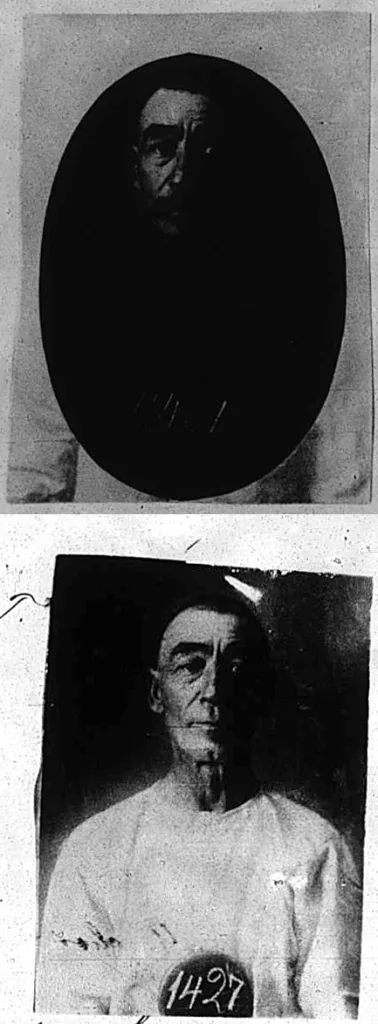
In December 1914, near Fort Mohave, close to the Nevada border, Robert Meara and his business associate, J.B. Wilson, were loading timbers onto a wagon. Standing on the wagon, Meara lost his footing. As he cried out, Wilson turned and briefly managed to catch hold of him. Both men fell to the ground, and Meara struck his head. A doctor was called, but the Irishman was dead. An inquest returned a verdict of accidental death.17
Just over 16 years earlier, Meara had been a prisoner at Yuma, serving a sentence of two years and six months for grand larceny of livestock. Aged around 48, he was Irish-born and privately educated. The prison register notes a gunshot scar on his right forearm. Officials placed his $57.50 and three account books in the prison safe, suggesting that he maintained active business interests outside prison.
Meara had arrived in Arizona by the early 1870s, residing in Mineral Park before settling in the growing mining town of Chloride. He initially worked in mining, later turned to cattle ranching, before returning to mining again.18
Upon his conviction, Meara appealed, questioning whether the livestock owners helped fund the prosecution. The Arizona Supreme Court rejected his appeal.19
He left Yuma once his sentence ended in October 1900 and returned to Chloride, where his business interests included ranching, mining and a saloon. In 1902, he confronted a business partner over non-payment, allegedly holding him at gunpoint. He forced him to write a cheque for approximately $800. At the trial, Meara was said to have been intoxicated.20 He was acquitted.21 In 1912, Meara himself became the victim of a robbery when someone stole approximately $600 from his safe overnight, a considerable sum at the time.22
Robert Meara did not die in a mine, a saloon or a prison. Instead, after more than 40 years in Arizona, he fell and struck his head on the Mohave County ground he had spent much of his life trying to make his own.
The Snipe and the Stabbing
James Haggerty
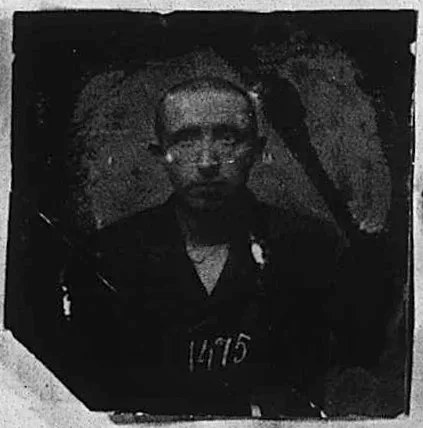
On a Sunday night in 1898, ten railroad labourers slept in bunks in a shared tent northeast of Kingman. At around 9pm, Kentucky native Harry Morgan and two others went outside before returning, talking about skinning mules and “working on the section”.
Morgan remarked that the only thing lower than a “skinner” was a “snipe” (a section hand, the bottom of the railroad maintenance hierarchy). According to contemporary newspaper reports, Haggerty overheard the remark and responded, “There are better men than you sniping, you son of a bitch!”
Morgan replied, “I’m not talking to you, and if you don’t shut up, I’ll go over there and smash your face.”23
The two men continued insulting each other before Morgan went to Haggerty’s bunk to fight him. Haggerty said, “Throw away your razor and fight fair”.
“I don’t need a razor to whip you!” Morgan retorted.
The pair exchanged blows, and Haggerty drove Morgan back towards the tent’s entrance, where he tripped over the foot of a bed. As the men struggled to their feet, Morgan cried, “Oh, Jesus, boys, he’s got a knife!”
They grappled through the door of the tent and after a short while, Morgan fell dead.23
He had been stabbed at the foot of Haggerty’s bed, with a trail of blood leading to the place where Morgan lay. There were seven distinct stab wounds, including a “horribly ugly” cut to his left arm that severed the muscles of the shoulder and nearly passed through the opposite arm.
Haggerty was convicted of manslaughter rather than murder and received a two-year sentence beginning in November 1898. Aged 35, he was described as small, dark-haired and stooped. In August 1899, he spent 28 days in solitary confinement for refusing to work. With an allowance for good behaviour, he was released in July 1900, four months early.
After his release, Haggerty’s trail largely disappears. A man named James Haggerty appeared in 1909, claiming to have found gold in the Swisshelm Mountains, near Arizona’s border with Mexico.24 It is uncertain whether this was the same man, and no further trace of the prisoner nor the gold prospector has been found. Unlike the others, Haggerty cannot be followed far beyond Yuma; the record holds him almost entirely within the shadow of a single night.
The Yuma register was created to reduce prisoners to identifying marks, measurements and offences. Yet those same records now preserve fragments of lives that extended far beyond the prison walls. The five Irishmen were killers, labourers, miners, husbands, fugitives and businessmen. Their mugshots captured them at the moment the Arizona Territory took possession of their identities. The scattered record allows us, imperfectly, to recover something of those identities.
References
- ‘Ed. Madden Killed’. The Coconino Sun. 16 July 1898. 9.
- Arizona, Yuma, Prison Records, 1884–1910. FamilySearch. https://www.familysearch.org/en/search/collection/4324902.
- ‘Life Sentence Commuted’. The Coconino Sun. 18 February 1905. 2.
- ‘Phoenix Enterprise’. The Oasis. 25 February 1905. 11.
- ‘Granted Full Pardon’. The Coconino Sun. 28 November 1913. 1.
- ‘Escaped Convict’. The Bay City Times. 20 June 1898. 5.
- ‘Police Court’. The Bay City Times. 22 November 1887. 3.
- ‘A Serious Charge’. The Bay City Times. 26 September 1887. 3.
- ‘Captured at Bay City’. The Saginaw News. 21 June 1898. 1.
- ‘Bay City News’. Detroit Free Press. 25 June 1898. 7.
- ‘James O’Connell…’. Arizona Republic. 19 February 1901. 3.
- ‘Arizona Day by Day’. Arizona Republic. 2 November 1899. 3.
- ‘The News of Jerome’. Arizona Republic. 9 August 1900. 8.
- ‘City and County News’. Weekly Journal-Miner. 29 November 1899. 3.
- ‘Touching Arizona’. Arizona Republic. 15 February 1901. 7.
- ‘A Jerome Delegate’. Arizona Republic. 15 September 1900. 7.
- ‘Robert Meara Killed’. Mohave County Miner. 5 December 1914. 2.
- ‘Multum News in Parvo Type’. Mohave County Miner. 15 April 1883. 3.
- Meara v. Territory of Arizona. Arizona Supreme Court. 15 March 1899. 6 Ariz. 299; 56 P. 718. Hall Approved. https://hallapproved.com/az/cases/supreme/1899/6598066/.
- ‘A Gun Play’. Mohave County Miner. 14 June 1902. 3.
- ‘Proceedings of the District Court’. Mohave County Miner. 25 October 1902. 2.
- ‘Chloride Robbery’. The Copper Era and Morenci Leader. 1 March 1912. 2.
- ‘Another Killing’. The Border Vidette. 24 November 1898. 1.
- ‘Believed To Be Old Mine Discovered by Swiss Helms in 1859’. Arizona Daily Star. 18 March 1909. 6.